Introduction
Small businesses face intense pressure to do more with less—faster customer service, tighter margins, and higher expectations for personalization. Artificial Intelligence (AI) and intelligent automation are no longer reserved for large enterprises. When applied strategically, AI consulting and automation deliver immediate operational gains, free up staff time, and create measurable revenue uplift for small businesses. This article shows how AI consultants and automation agencies tailor solutions for small-business needs, which workflows to prioritize, how to measure ROI, and a practical implementation roadmap you can apply today.
Real Results — Automate Workflows and Measure ROI
Why AI and automation matter for small businesses
- Efficiency at scale: Automating repetitive tasks (invoicing, order routing, customer follow-ups) reduces manual errors and labor costs while freeing time for high-value activities like sales and product improvement.
- Better decision-making: Lightweight machine learning models turn small-business data—sales, customer behavior, inventory—into actionable predictions (demand forecasting, churn risk, upsell opportunities).
- Competitive differentiation: Faster response times, personalized outreach, and automated fulfillment improve customer experience and retention, making smaller players more competitive.
- Cost-effective access to talent: Working with an AI consultant or an AI automation agency gives access to specialized skills without hiring a full data science team
Key workflows to automate first (high impact, low complexity)
Customer support triage
- Use chatbots and AI intent classification to resolve common queries, escalate complex issues, and capture leads outside business hours.
Lead qualification and nurture
- Automate lead scoring with simple ML models, and trigger personalized email/SMS sequences based on behavior.
Order processing and fulfillment
- Automate order validation, inventory checks, and shipping label generation to reduce delays and manual errors.
Accounting and invoicing
- Use OCR and RPA to extract invoice data and reconcile payments automatically.
Marketing optimization
- Automate ad budget shifting and creative testing based on conversion signals and ROI thresholds.
Employee scheduling and capacity planning
- Predict peak hours and generate optimized schedules to reduce overtime and understaffing.
How to measure ROI: metrics and a simple formula
How to measure ROI: metrics and a simple formula
Financial metrics:
- Revenue uplift (ΔRevenue attributable to automation)
- Cost savings in labor (hours saved × fully loaded hourly cost)
- Reduced error/return costs
Operational metrics:
- Time-to-fulfillment
- First-response time (support)
- Conversion rate lift (marketing/sales)
- Customer satisfaction (CSAT/NPS)
Adoption metrics:
- Percentage of tasks automated
- User satisfaction and reduction in manual touch-points
A simple ROI formula you can use:
ROI=Net BenefitProject Cost×100=(Revenue Uplift + Cost Savings – Ongoing Costs)Implementation Cost×100\text{ROI} = \frac{\text{Net Benefit}}{\text{Project Cost}} \times 100 = \frac{\text{(Revenue Uplift + Cost Savings – Ongoing Costs)}}{\text{Implementation Cost}} \times 100 ROI=Project CostNet Benefit×100=Implementation Cost(Revenue Uplift + Cost Savings – Ongoing Costs)×100
Example: If automation delivers $30,000/year in labor savings and an extra $20,000/year revenue, with implementation cost $25,000 and annual maintenance $5,000:
Net Benefit = (30,000 + 20,000 – 5,000) = 45,000
ROI = (45,000 / 25,000) × 100 = 180%
Make sure to calculate payback period (Implementation Cost / Annual Net Benefit) to show how quickly the investment returns.
Industry-specific examples for small businesses
Retail (local boutique)
- Use demand forecasting for inventory reordering, chatbot for order status, automated email campaigns for abandoned carts. Result: fewer stockouts, higher conversion rates.
Restaurant / Cafe
- Automate online order routing, predict busiest hours for staffing, and use AI-driven personalized promotions to increase repeat visits.
Professional services (accountants, lawyers)
- Automate document intake and simple triage, schedule client appointments automatically, and use analytics to identify cross-sell opportunities.
Local healthcare clinic
- Automate appointment reminders, simple symptom triage via secure chatbot, and optimize staff schedules to reduce no-shows.
Home services (plumbers, electricians)
- Route jobs intelligently based on proximity and skill set, automatically collect payments and follow-up reviews to boost reputation.
Case study (concise, actionable)
Local bakery with 6 employees:
- Problem: Frequent stockouts of top-selling items, long customer wait times online, manual bookkeeping consuming 15 hours/week.
- Solution roadmap:
- Implement a lightweight demand-forecasting model using 6 months of POS data to predict daily production quantities for top items.
- Add an automated ordering and inventory alert system tied to a supplier API.
- Deploy a chatbot to handle pickup times and FAQ; integrate with POS for simple order confirmations.
- Use OCR/RPA to extract receipts and automate bookkeeping entries.
- Results (6 months): 20% reduction in food waste, 15% increase in morning sales due to better-stocked items, 60% reduction in bookkeeping hours. Payback period: ~4 months.
Implementation roadmap for small businesses (step-by-step)
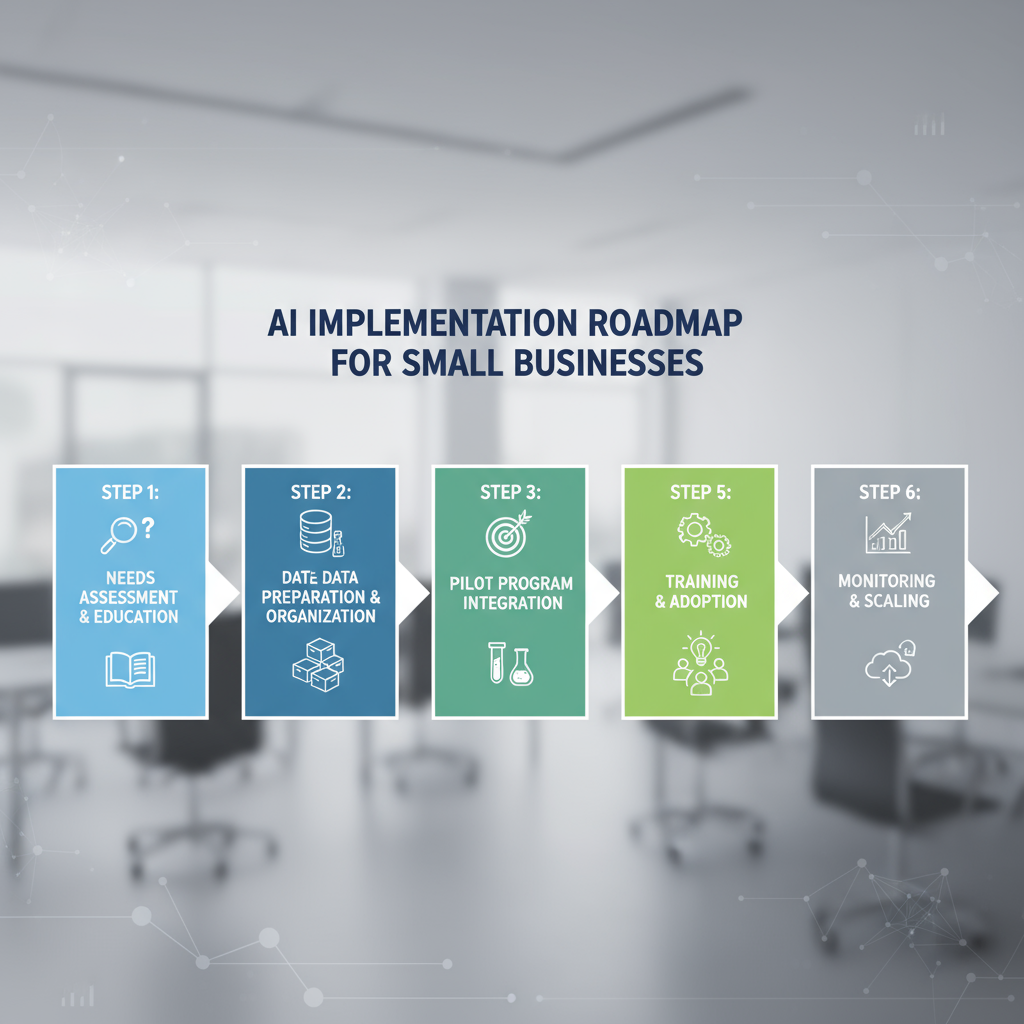
Audit & prioritize (1–2 weeks)
- List processes, map time spent, and estimate business impact and complexity. Score each workflow by ROI potential.
Quick wins (4–8 weeks)
- Implement 1–2 low-complexity automations (chatbot, invoicing automation) to prove value and build internal buy-in.
Build or integrate (8–16 weeks)
- For higher-impact processes, deploy ML models or integrations (CRM, POS, accounting). Keep scope tight and iterative.
Measure & iterate (ongoing)
- Track KPIs established in the audit; refine models and automations monthly.
Scale (3–12 months)
- Automate adjacent workflows, centralize data, and, if needed, move to more advanced orchestration (event-driven pipelines, automated retraining).
Governance & maintenance (ongoing)
- Assign an owner, set retraining cadences, monitor model performance for drift, and maintain data privacy/compliance.
Choosing the right partner: what to expect from an AI consultant or agency
- Practical expertise: Look for experience with small-business tech stacks (Shopify, QuickBooks, Square, Google Workspace) rather than only enterprise platforms.
- Rapid prototyping: Ask for a PoC (proof of concept) in 4–8 weeks and clear KPIs.
- Cost transparency: Fixed-price pilots, clear ongoing maintenance fees, and predictable pricing for scaling.
- Data privacy & compliance: Especially important for industries handling personal or health data—ask about encryption, retention, and deletion policies.
- Train-the-trainer approach: Consultants should enable your team to operate and maintain automations, not create perpetual dependency.
Common pitfalls and how to avoid them
- Overwhelming scope: Trying to automate everything at once increases risk. Start with high-impact, low-complexity tasks.
- Poor data quality: Garbage in → garbage out. Spend time cleaning sales, customer, and operations data before model training.
- Lack of measurement: If you don’t baseline current performance, you can’t attribute gains to AI. Establish KPIs up front. Ignoring change management: Staff pushback is common.
- Involve users early, provide training, and highlight time saved. Hidden costs: Factor in integration, monitoring, and periodic retraining when budgeting.
Tools and technology stack recommendations (small-business friendly)
- CRM & marketing: HubSpot (starter), Mailchimp, ActiveCampaign
- E-commerce & POS: Shopify, Square, Lightspeed
- Automation & RPA:
- Zapier — https://zapier.com/
- Make (formerly Integromat) — https://www.make.com/en
- n8n — https://n8n.io/ (self-host or cloud; great for low-code to code-flexible workflows)
- Chatbots & conversational AI: Landbot, Tidio, Dialogflow
- Accounting automation: QuickBooks with receipt capture tools (Dext), Xero
- Lightweight ML & analytics: Google Sheets + BigQuery Sandbox for simple models, AutoML tools (Google Vertex AI or AWS SageMaker Canvas) when working with an agency
- Reporting & dashboards: Google Data Studio / Looker Studio, Metabase
Note: Learn more about the automation platforms linked above — Zapier, Make and n8n — to see which matches your technical comfort, security needs, and budget.
Budgeting and timeline expectations
- Quick wins: $2k–$10k and deliverable in 4–8 weeks (chatbots, Zapier/Make/n8n automations, OCR invoicing).
- Mid-range projects: $10k–$40k for integrations, simple ML models, and custom dashboards (8–16 weeks).
- Larger automation programs: $40k+ for full orchestration, advanced models, and multi-system integrations (3–9 months).
Note: Costs vary by geography, data complexity, and whether you use full-service agencies or freelancers + SaaS tools.
How to evaluate success (KPIs to track first 90–180 days)
- Operational: Hours saved per week, reduction in manual tasks, processing time per transaction.
- Financial: Labor cost saved, increase in revenue or conversion rate, reduction in error-related costs.
- Customer: First-response time, CSAT score change, repeat purchase rate.
- Adoption: % of team using new tools, volume of tasks handled by automation.
Actionable checklist for small-business owners (next 30–90 days)
- Run a 1-week time audit to identify repetitive tasks.
- Score tasks by impact and complexity; choose 1–2 quick wins.
- Request 2–3 proposals from consultants/agencies with relevant small-business experience.
- Launch a fixed-scope pilot with clear KPIs (4–8 weeks). Evaluate results and plan scaling steps for the next 3–6 months.
Conclusion
AI consulting and automation are practical, attainable levers for small businesses seeking efficiency and growth. By focusing on high-impact, low-complexity workflows, measuring results rigorously, and choosing partners experienced with small-business ecosystems, owners can realize rapid payback and sustainable improvement. Start with a targeted pilot, track the right KPIs, and scale gradually—this pragmatic approach turns AI from a buzzword into a predictable engine for productivity and revenue.
Ready to turn one routine task into measurable savings? Reply with your top 2–3 pain points (e.g., invoicing, order routing, support triage) and I’ll draft a 30–60 day pilot plan tailored to your small business — including estimated costs, KPIs, and suggested tools (Zapier / Make / n8n where appropriate). Which two problems should we prioritize?